


Love Local - Shoreham-by-Sea: Where River, Sea and History Unite
From its medieval port and historic buildings to its riverside walks, creative spirit and beautiful beach, Shoreham-by-Sea offers a blend of heritage, nature and contemporary coastal living...

Shoreham-by-Sea sits where the River Adur meets the English Channel, with the South Downs rising to the north and Shoreham Beach stretching along the coast, it is a town shaped by water, trade, industry and landscape.
Today, Shoreham offers independent shops and cafés, galleries, restaurants and cultural venues alongside centuries-old buildings, working boats, wildlife-rich waterways and a beach that feels a world away from the busier resorts nearby. It is sufficiently close to Brighton and Worthing to benefit from their amenities yet retains a strong community atmosphere and distinct character of its own.
Shoreham's history stretches back much further than its attractive Georgian and Victorian streets might suggest. The settlement was recorded in the Domesday Book in 1086, while archaeological evidence points to occupation in the wider area for thousands of years. The River Adur was to become central to Shoreham's development, providing a natural route for ships and helping establish the town as an important medieval port.

By the Middle Ages, Shoreham-by-Sea was a significant centre for shipping and commerce. Its location made it particularly valuable for transporting goods, and its shipbuilders developed an impressive reputation. The port reached a notable moment in the 14th century when Shoreham supplied more vessels for Edward III's campaign in France than several much larger English ports.
The town's fortunes changed over the centuries as the course of the River Adur shifted and coastal erosion altered the landscape. Nevertheless, shipbuilding and maritime trade remained important, and the harbour continued to influence the town's character. That connection with the water remains visible today, from working boats and waterfront industries to the houseboats along Shoreham Beach.
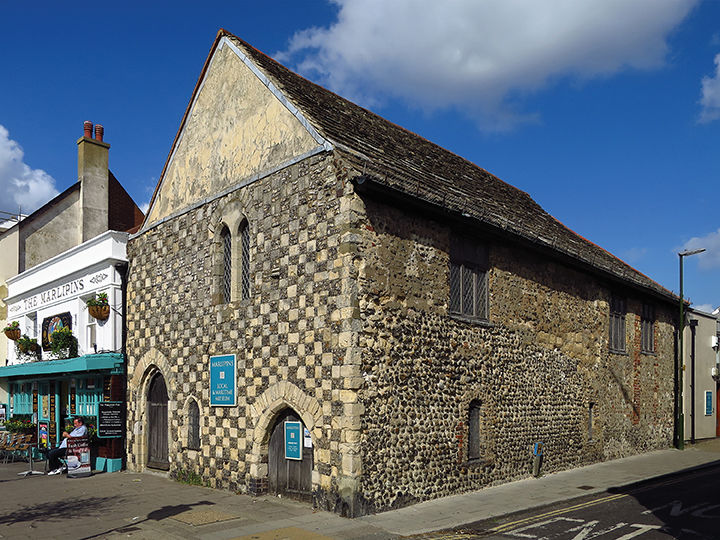
One of the great pleasures of exploring Shoreham-by-Sea is discovering how much history survives within a relatively compact town centre. Perhaps the most remarkable building is The Marlipins – a medieval building on the High Street whose origins date back to the 12th century. Its distinctive façade, combining pale stone and flint in a chequerboard pattern, makes it instantly recognisable. It was associated with the medieval port and is now home to the Marlipins Museum, which explores Shoreham's maritime and local history.
Another architectural highlight is St Mary de Haura – the magnificent church at the heart of the town. Dating from the 11th century, it is particularly significant for its architecture, representing the transition between Romanesque and Gothic styles. Its substantial scale is a reminder of Shoreham's importance during the medieval period.
The River Adur gives the town a constantly changing landscape, with the character of the river shifting according to the tide, weather and season. The Adur Ferry Bridge provides a pedestrian and cycling connection between the town and Shoreham Beach. Its glass-sided structure offers wonderful views along the river and towards the harbour, making the crossing an attraction in its own right.
For walkers and cyclists, the river provides an opportunity to slow down and appreciate the landscape. The towpaths and riverside routes offer plenty of wildlife to spot with the mixture of mudflats, shingle, water and grassland creating an important environment for birds and other wildlife.
Cross the river and the atmosphere changes again. Shoreham Beach is a long shingle beach backed by a distinctive collection of homes, vegetation and waterways. The beach is popular with walkers, families and watersports enthusiasts, while a boardwalk provides an accessible route along part of the coastline. The estuary is also notable for its unusual houseboat community – which has roots stretching back to the 1920s, giving the waterfront an individual and rather bohemian character.
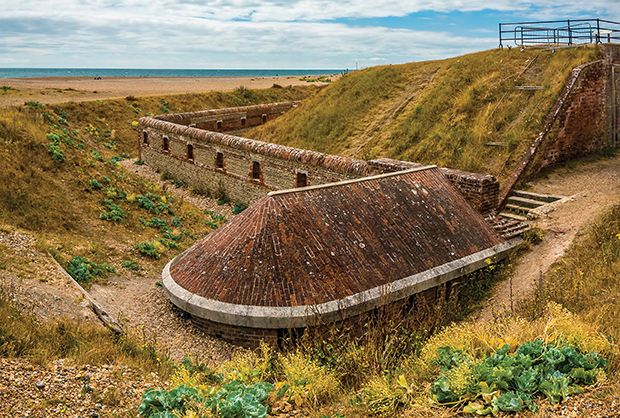
At the eastern end stands Shoreham Fort, built in 1857 to defend the harbour entrance. It was part of the Victorian coastal defences created when fears of French invasion prompted Britain to strengthen its shoreline fortifications. The fort was completed in the same year construction began and was designed to command the harbour entrance and approaches from the sea. Today, the fort provides an intriguing glimpse into Shoreham's military history and a wonderful vantage point over the coast.
Another fascinating chapter in the history of Shoreham-by-Sea can be found at Brighton City Airport, which was formerly known as Shoreham Airport. The airport is the oldest airfield still operating in the country – with the first recorded flight taking place in 1910. The airport's 1930s Art Deco terminal building is one of its most striking features with its geometric exterior and original features still standing proud today.

Although history is everywhere in Shoreham, this is certainly not a town trapped in the past. The Ropetackle Arts Centre, beside the River Adur, has helped establish Shoreham as a lively cultural destination, presenting music, theatre, comedy, talks and family entertainment. The town also has a strong independent spirit, with community events, markets, cafés, galleries and specialist shops contributing to its appeal. Its creative character is perhaps unsurprising with the combination of river, sea, historic buildings and boats providing endless inspiration.
For visitors, Shoreham makes an excellent destination for a day out – but it is equally rewarding if explored slowly. Start with the old town and its historic buildings, stop for coffee or lunch, wander beside the Adur, cross the ferry bridge and explore Shoreham Beach. Visit the fort, watch the boats and birds, or simply sit beside the water and watch the tide change.
What makes Shoreham-by-Sea special is the way the different identities overlap. Take the time to look a little closer and you discover layers of history, architecture, nature and community – all gathered around one beautiful stretch of Sussex where the river meets the sea.


Comments